PRE-LAUNCH SALE Ends on 30/03/2026
Learn to Visualise, Internalise & Vocalise
ALL 12 Major Pentatonic Scales
with our simple 7-Day Course !
SaxCircle-Maj-Pentatonics is for anyone who struggles with the traditional way to learn scales and wants to finally unblock their SAX playing enjoyment!
PRE-LAUNCH SALE!
Join before 30/03/2026 and get our course Bundle - "Major & Minor Pentatonic Scales" & "Bluesing it Up" for only £29.99 (Normally £59.97). One Time Pre-Launch Offer.

"My ADHD made learning scales boring, unmemorable and too challenging for me - not anymore!" - Lee W.
"Previously I was told to persevere, to learn the scales parrott fasion. Adding a visual tool made all the difference." - Pete O.
"I quit playing, something was missing. Now I can visualise the scales through simple patterns. - John P.
You've stopped and started too many times!
You want to give it one more go, because you've always dreamt of playing sax.
❌
Problem #1
Learning music theory on a sax is hard. You can't see what your are doing, unlike a Pianist. Something is missing!
❌
Problem #2
Scales with 4, 5 or 6 (#)sharps or (b) flats seem impossible. Each one seems harder and more awkward to play and memorise. It's the point I always struggle.
❌
Problem #3
Without the musical alphabet, playing was frustrating and stifled, often the only player in the band with a stand and sheet music, in flexible.
Introducing our simple
7-Day course to allow you to visualise, internalise and vocalise, ALL 12 Major Pentatonic SCALES!
✅
Solution #1
The Sax Circle's unique simple concept gives sax players the same visual advantage as guitarists and keyboard players. The magic third sense - visualisation.
✅
Solution #2
The one tool and simple, easy to learn patterns, make each scale as simple and easy as the next regardless of (#)Sharps/(b)Flats. Being able to visualise the pattern & scale makes it memorable and internalised.
✅
Solution #3
Once internalised, the Sax Circle will allow you to transpose from Guitar/Keyboard keys to your instrument and join in with others more easily. To 'sing' and vocalise through your Sax.
Plus So Much More!
Scroll down to see everything you get lifetime access to...
SaxCircle-Maj-Pentatonics
Course Curriculum
Day 1 - Welcome
My Story: I share how I struggled learning to play with confidence and the lightbulb moment I recently figured out why.
A Clear Outline: I explain clearly what the course will help with in relation to your own sax playing and;
How The Courses Stack: from the foundation of the SaxCircle, through to the different patterns building on the foundation.
Theory Lesson 1: Quick introduction to a scale and the scales covered by the courses.
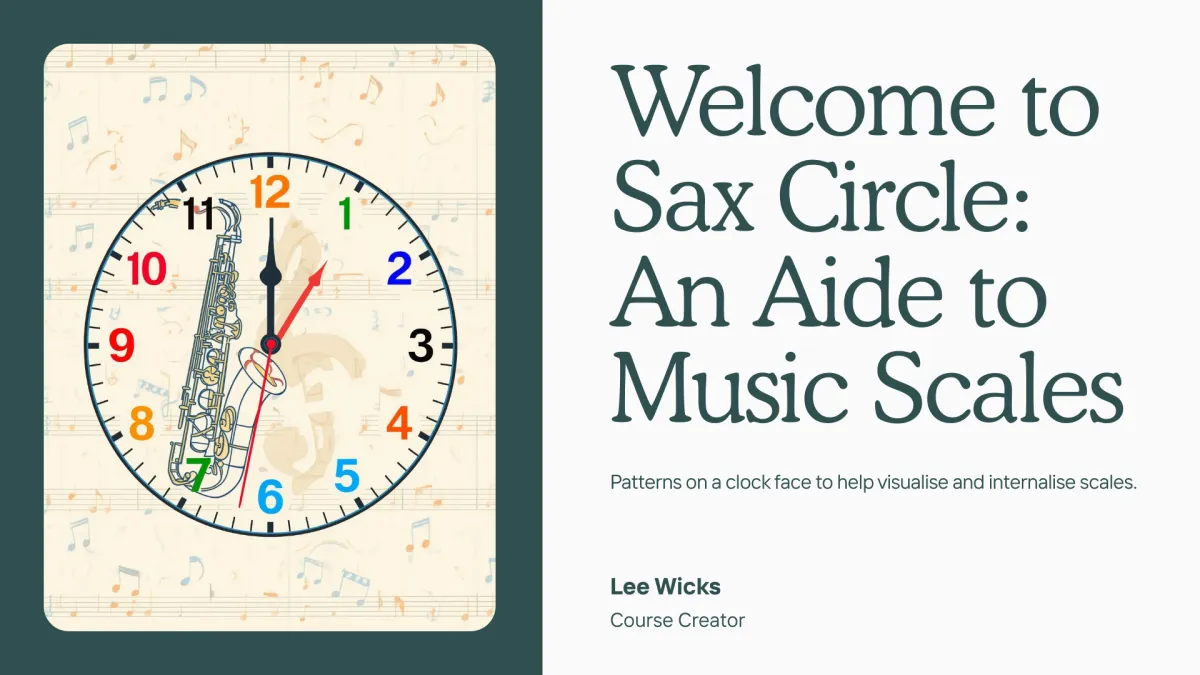
Day 2 - Rock the Clock
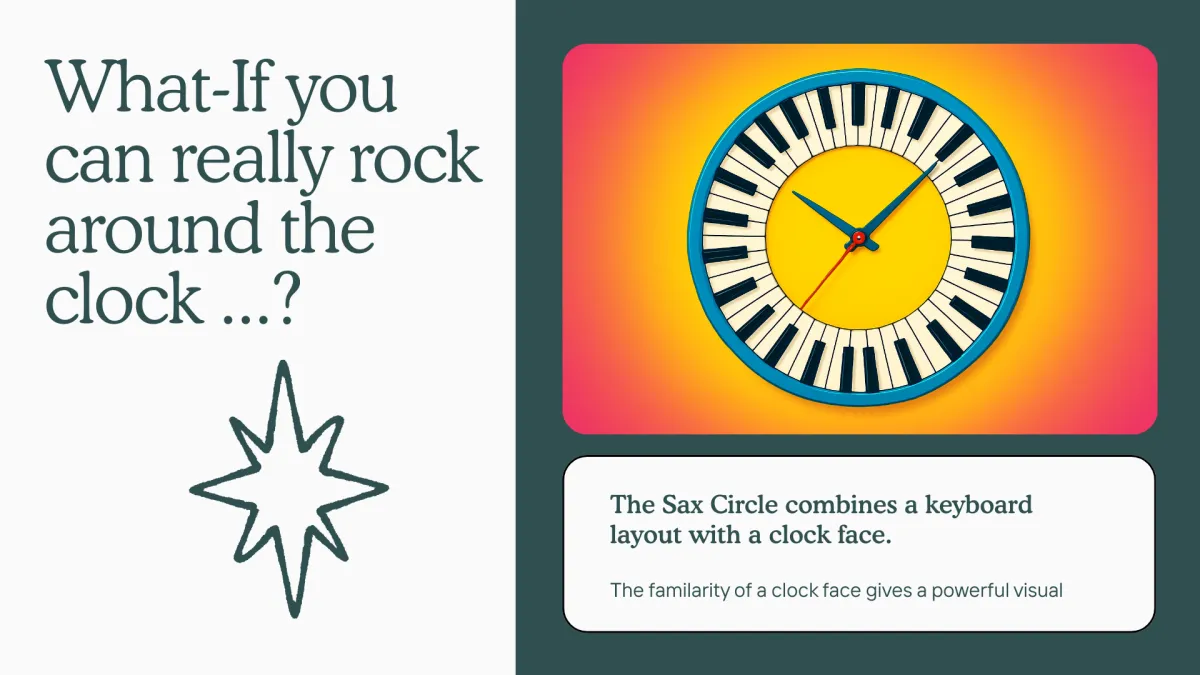
The missing sense: Keyboard players can hear, touch and see the notes and patterns of the scales, so can guitarists. The course shows you how a simple tool can help us create a visualisation.
The Clock: A clock is so familiar to us all, it's the perfect tool to use as our fretboard / keyboard.
Serendipity of 12: There are 12 notes and 12 hours around a clock face - that was lucky. Our unique set up and patterns take advantage of this.
Layout: It is the layout of the 7 white notes and 5 black notes that are arranged a certain way that create the tool.
Theory Lesson 2: Practice the chromatic scale and some intervals or steps.
Day 3 - See it in your mind
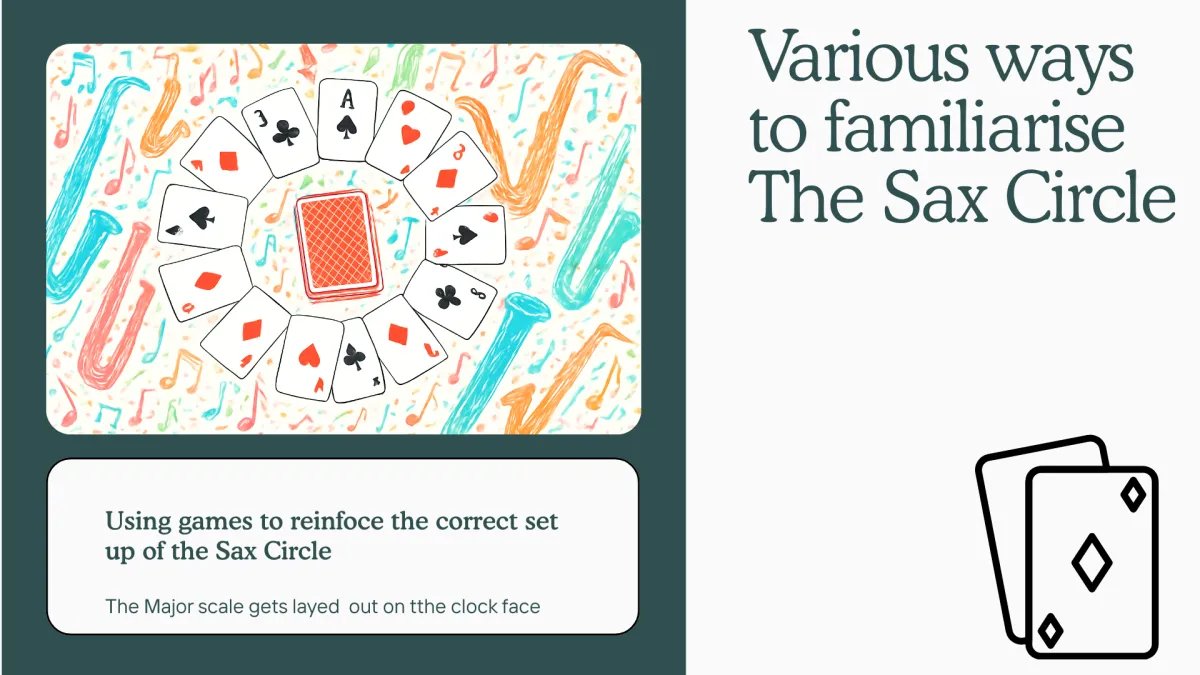
Reproduction: Provides various ways to learn and reproduce the Sax Circle
Games: Use the clock patience card game with a set of bespoke carrds.
Familiarise yourself: by playing on your sax, by going around the notes on the clock.
Build familiarity: Playing around the clock in different directions and different starting points.
Theory Lesson 3: Octaves & Pinkies
Day 4 - Pattern One
Learning: A simple three note pattern and moving it round the clock is a great starting point.
Combine: Day 2 & Day 3 into a practice to lay the ground work
Theory Lesson 4: Triads & Chords
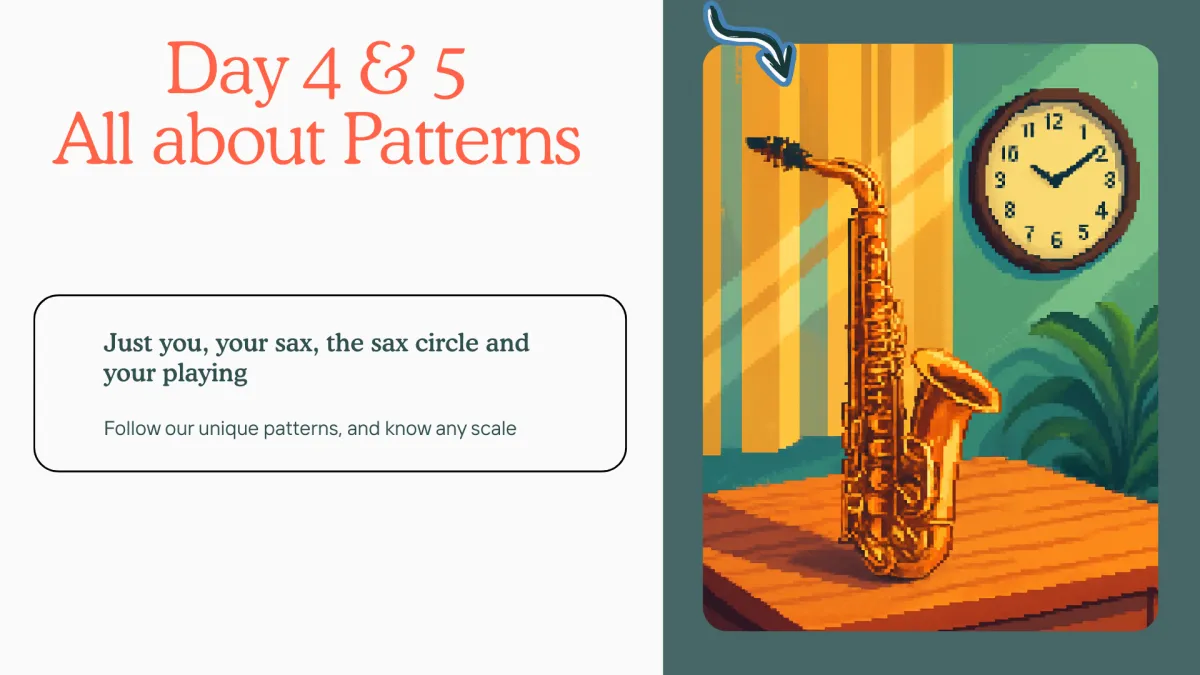
Day 5 - Pattern Two
To complete: the major pentatonic scale, combine the 2nd pattern with the 1st pattern and play this around the clock
Reinforce: your learning by playing in the other direction
Really own it: by starting from a different place on the clock face.
Theory Lesson 5: Major v Minor
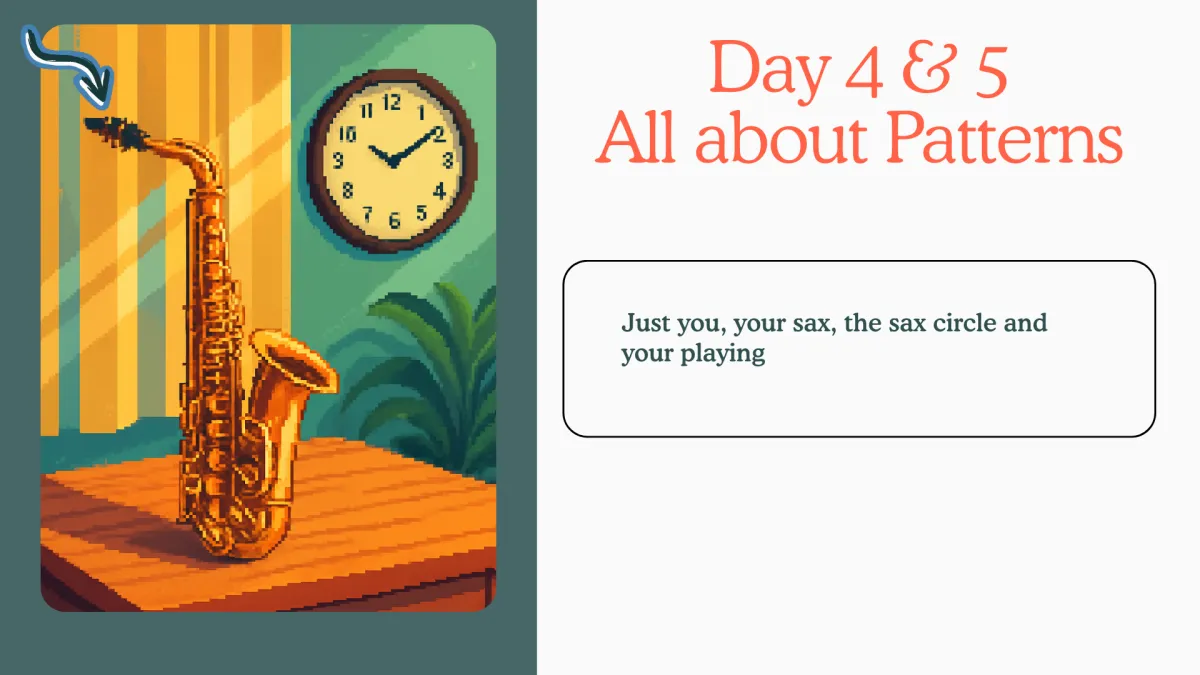
Day 6 - Basic improvisation
Play-along: Using one of the backing tracks and using the the key provided, play anything you want.
Feature: And how that speeds them to their desired result
Benefit: What's your market desire most, what makes their mouth water?
Theory Lesson 6:
Day 7 - Take it to the Jam
Soloing:
Jamming: What's your market desire most, what makes their mouth water?
Limited Time Pre-Launch Bonuses
Amazing Bonuses
Private Community: Get all your questions answered daily so you are never second guessing or wasting time!
Customized Course: The course will be built around your specific needs as an early adopter. This is something that folks will not get to experience with the finished course!
Any Other Bonuses:
What's Included In SaxCircle-Maj-Pentatonics
Meet Your Instructor

[Intro]
My name is Lee and I've had a saxophone in my hands since I was 12 years old. The song (or album) that first got my sax juices buzzing was Pink Floyd - Dark Side of the Moon - Money, played by Dick Parry. My Dad had a few jazz records, but growing up in the 80's there were lots of inspiring sax solos on pop records.
[Teachers | Bands & History] I started with lessons at school and played in the school band and two fun bands with friends. Phase 2 I was married by now and started playing again when a work band started, I desperately needed some lessons and found another teacher. Phase 3 was when I was divorced, in a new job and a new work band and a new teacher. Phase 4 was when I got married again and played with the wedding band at my wedding. Had a few lessons with the excellent band sax player but had to fake my way through the set. I stopped playing again. Phase 5, I found a new teacher, who turns out was a very good player, british blues intstrumentalist of the year. She emergrated and offered me her Yanni Tenor which I bought and I have loved since. So Phase 6, I found an online sax community, in fact I tried a few of them but settled with Get Your Sax Together - Jamie Anderson. Through this community I may be able to pass on some things I have learnt and am learning. It will be a life long passion and a way to know myself and improve.
[If you can take anything away from from the course and my story it is to persevre til stuck and then overcome and persever some more.
[Scales are boring to learn. Scales are hard to learn. Scales with 4, 5 or 6 accidentals (Sharps & Flats) are impssible to learn. These were my limiting belief to playing. And guess what the #1 thing I've learned throughout this entire journey is...? 👉 Hard is the destination you need to get to. There is frustration, angst, fear and avoidance. I gave up time and again, until I had to decide to finally quit for good or overcome the blocker, I only really had one choice! I love the sax too much. AND THAT RIGHT THERE is what led me to realise I need to use three senses to learn; Sight, Sound and Touch in this case. My memory just doesn't really work when I only engage two senses, especailly when the content and method are really boring. And so I set about creating a way to have visual recall of scales through patterns and and a very very common device that is second nature to everyone. AND THE SAX CIRCLE WAS CONCEIVED.
Who Is This Course For?
You have struggled to learn the scales, the alphabet of music, especially the 'knarly' keys.
You want to get up and jam with others but don't know how.
You gave up frustrated, want to start playing again but don't know how to get past some blockers.
What Categories Do We Focus On?
A complete beginner of any age
A sax player wanting to solo more confidently
A returning sax player
An intermediate player struggling with the knarly keys C# 5 sharps.
An amature occasional sax player
A sax player who wants to play with other musicians
And anyone who struggles to play a scale from memory but then from just knowing it
Even other woodwind players will benefit.
Who Is This Course NOT For?
If you know your full major and minor scales already or...
You're happy with the tools you're using to practice your scales to key your fingers fresh or...
You're not really a visual learner.
Frequently Asked Questions
What skill level is this course for?
This course is for beginners upwards. No musical knowledge is required and some will be taught during the course. You should be able to play the basic 12 notes on your saxophone as a minimum. The course is for anyone who is struggling to learn and remember the 12 Major Pentatonic Scales
What skill level is this course for?
The pentatonic scale is five notes and should be the simplest scale to play and learn. So it is a good starting point and a good place to build other scales from. Also, most western pop, rock and blues songs can be played along with using the right 5 notes, the right pentatonic scale.
How long do I have access to the course & when does it start?
You will have lifetime access to the course. But more importantly you'll have lifetime access to the musical alphabet. The course starts and is available as soon as you purchase it and are ready to begin.
Can't I learn all of this on Youtube?
There is a lot of great saxophone tutorial content on YouTube. There are great teachers and communities and online schools and "inner-circles". But nothing has helped me overcome my struggle to visualise, internalise and vocalise the basic major and minor scales. All of the traditional ways haven't worked for me, so I created The Sax Circle.
Do I need to have a saxophone before starting?
L
Should I know music theory before I invest in SaxCircle-Maj-Pentatonics
You will have some basic music theory to recognise your current struggle to learn scales. The simple concepts discussed and used on the course is will hopefully introduce some useful music theory. I may have taken a music grade at school, 45+ years ago, so my music theory knowledge is very limited.